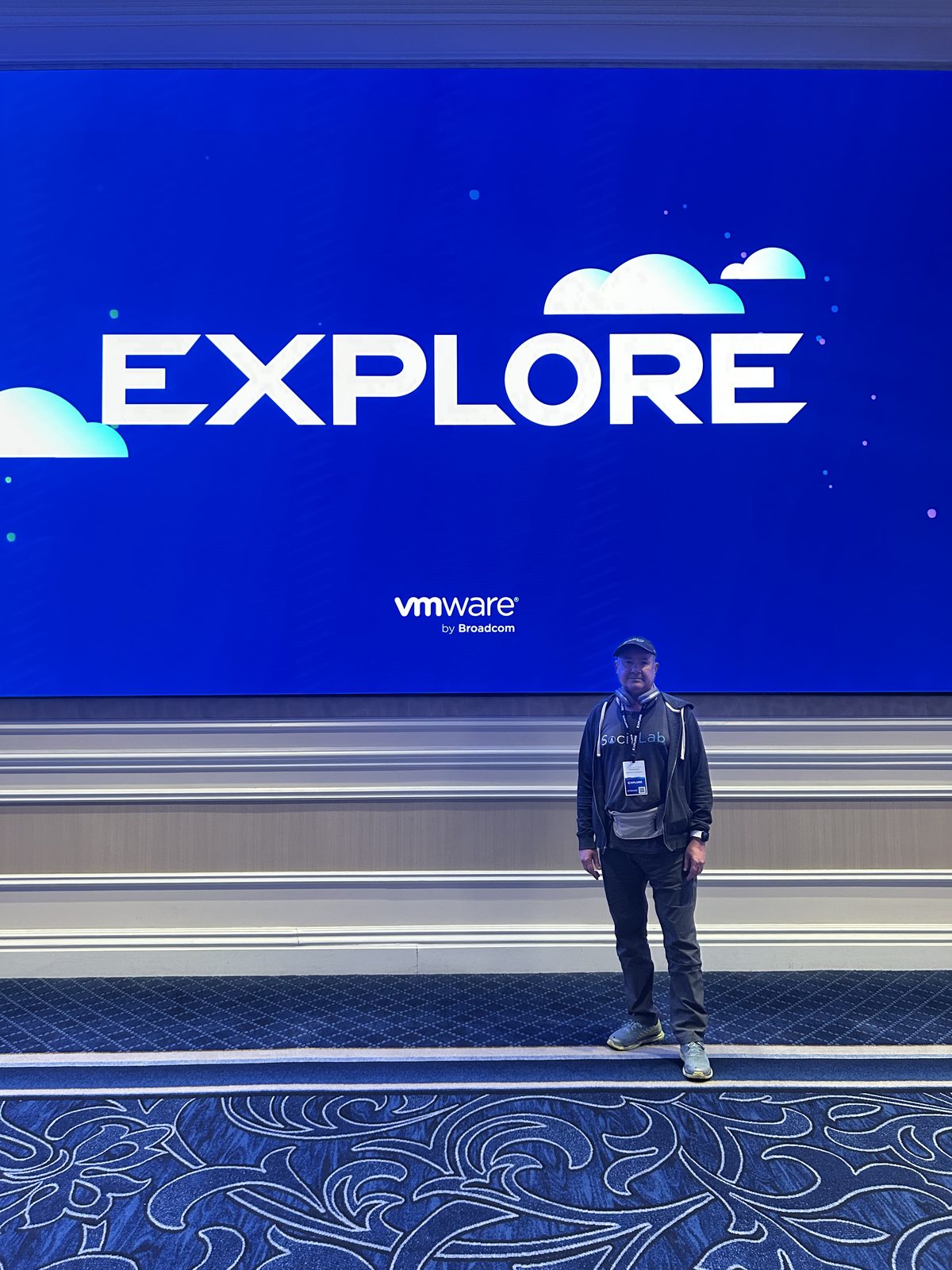
I landed in Las Vegas on Sunday, a full day ahead of the crowd, and had my badge in hand before most attendees had checked into their hotels. That bought me an afternoon to walk the venue while it was still empty — no lines, no lanyards, nobody standing in a doorway looking at a map. Just carpet and signage and a lot of chairs waiting for people.
Monday morning at 8:52 I stopped in front of the schedule board and took a picture of it. I do this at every conference. It is the single most useful photo you take all week, because the app will crash, the printed guide will end up in a tote bag under a chair, and the board is the only version of the day that can't lose signal.
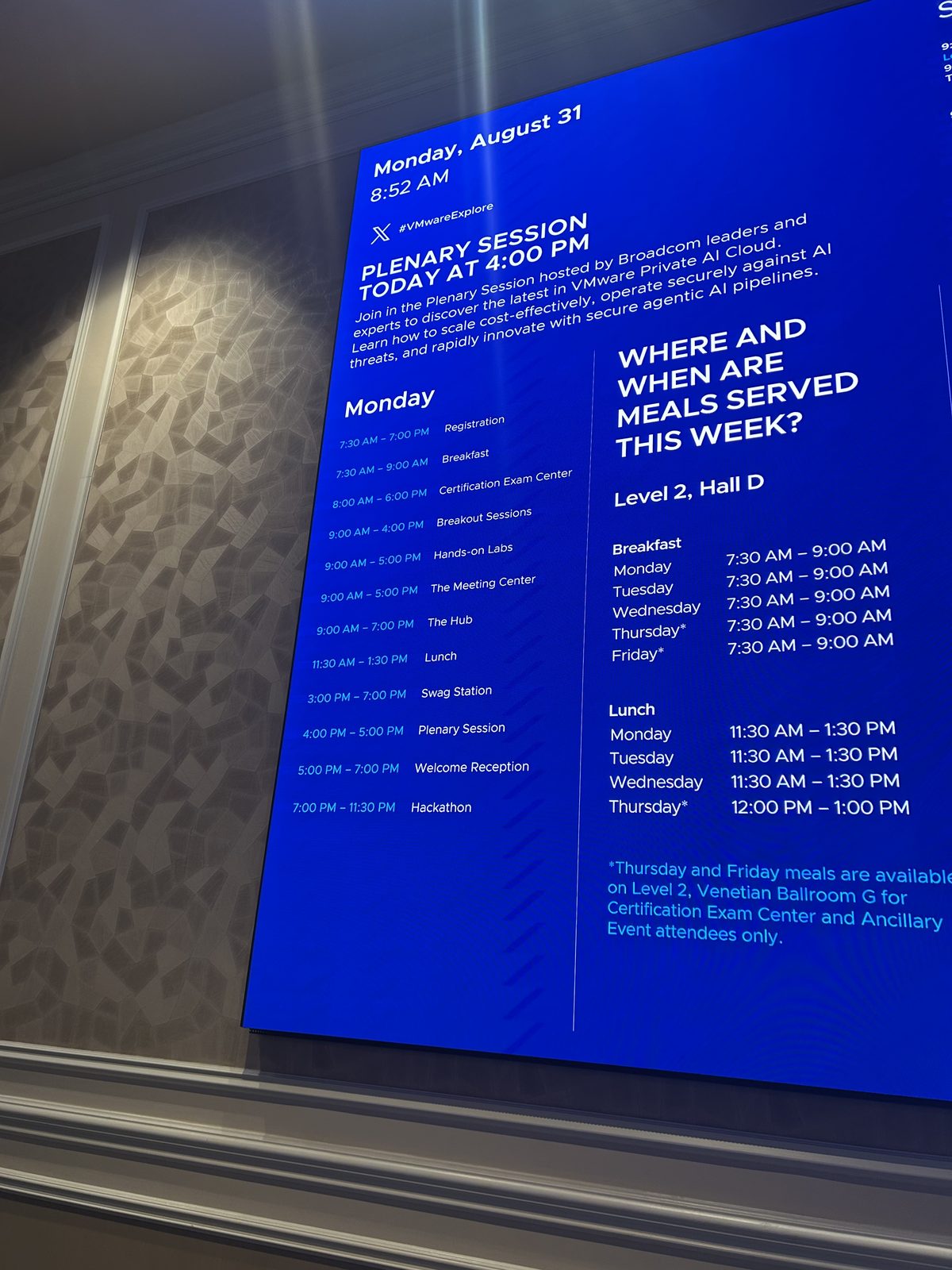
Registration at 7:30. Breakfast until nine. Breakouts nine to four. Hands-on Labs and the Hub all day. Lunch at 11:30. Swag Station opening at three. Plenary Session at four. Welcome Reception at five. {code} Hackathon, seven to eleven-thirty.
Of everything on that board, the two items in the largest type are the two I did not attend. One I missed because I was three floors away. The other I had already decided, weeks earlier, not to walk into. This post is about how a day you planned in advance goes somewhere else while you're standing in it.
The morning went sideways in the most predictable way
I spent weeks before this trip building what I'd been calling Operation Swag — a sequenced plan for every giveaway, point game, booth scan, and drawing at the event. Sponsor passport, nine booths. An expedition point game with three tiers and a Wednesday expiry. Odyssey qualifying rounds. Present-to-win drawings with alarms set for each one.
It worked. That's the problem. I built a second conference on top of the first one and then spent Monday attending both of them badly — moving between booth theater sessions and the Hub with one eye on the content and one on a checklist, absorbing about sixty percent of anything.
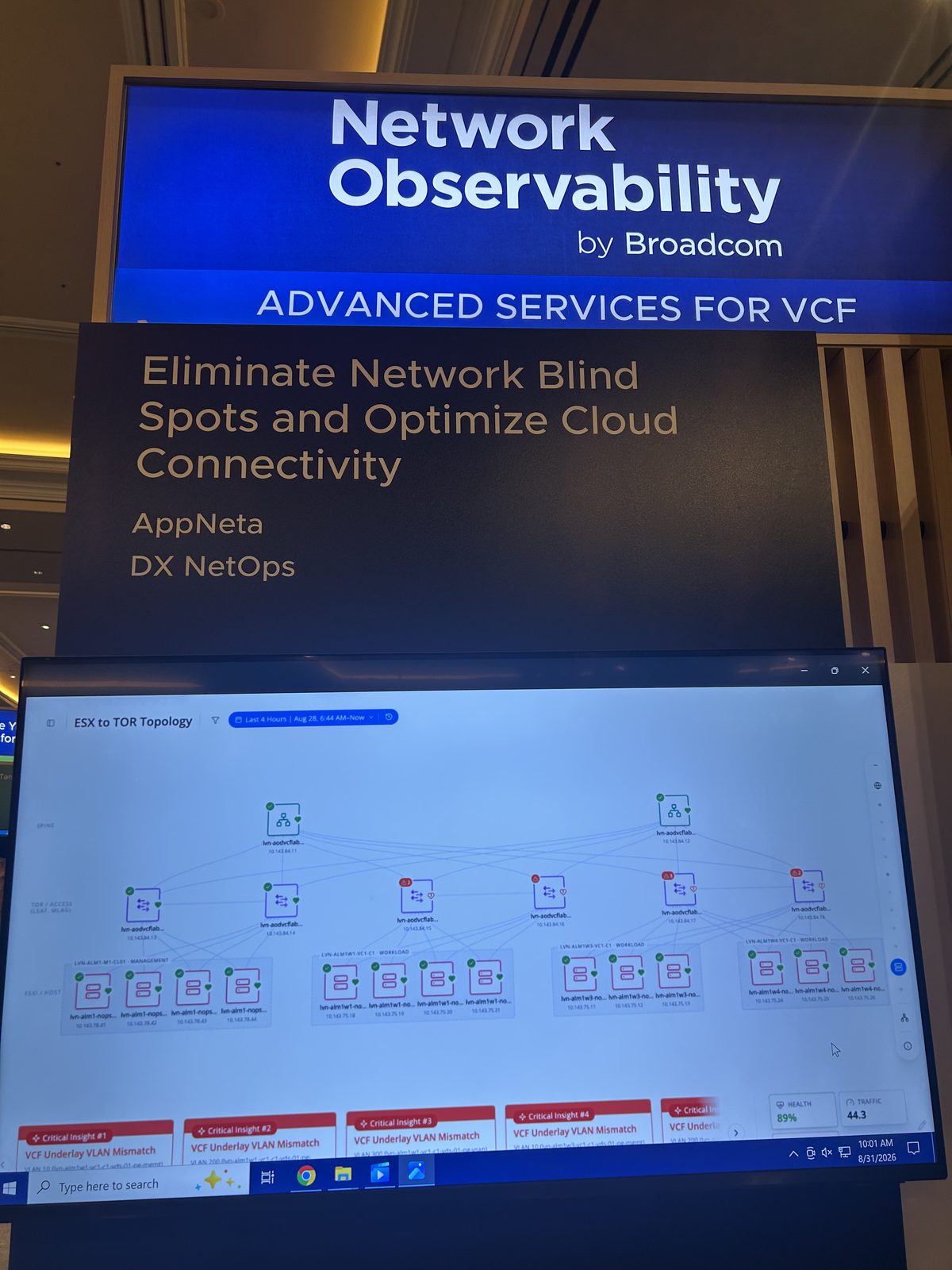
That screen is the one piece of Monday morning that stuck. Not because the product is novel — because I have spent afternoons chasing exactly that class of problem through switch configs and vCenter, and here it was surfaced on a topology map in red before anyone had to go looking. I stood there longer than the checklist wanted me to.
Four o'clock
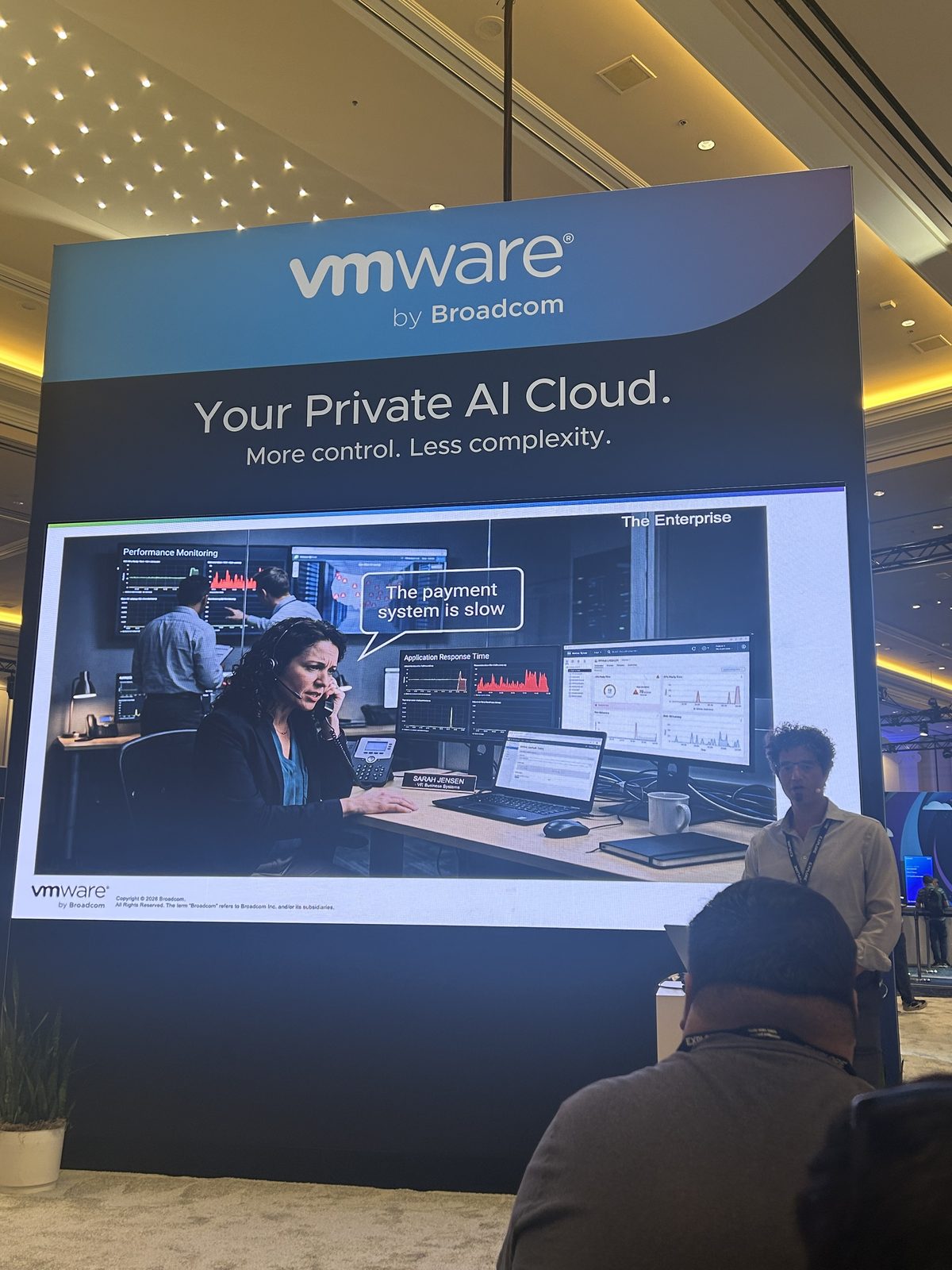
The plenary was VMware Private AI Cloud, hosted by Broadcom leadership, four to five in the afternoon. It is the session everybody writes about. It is the reason a lot of people fly out.
I was on Level 3 running Odyssey qualifying rounds for points that expired Wednesday.
I'm not going to dress that up. I traded the keynote for a game. The honest defense is that the Odyssey material is straight VCF Operations content and I had an exam on Thursday in exactly that domain, so the hour wasn't wasted — but I didn't choose it for that reason, I chose it because the points were about to expire and the plenary wasn't going anywhere. That's the logic of a completionist, not a professional, and it cost me the one session I can't get back.
Build the swag plan if you enjoy it — I did, genuinely, and it produced a good week. But put the immovable content on the board first and let the game route around it, not the other way around. A point total expires on Wednesday. A keynote you skipped is gone for good, and no amount of reading about it afterward puts you in the room.
Seven o'clock
The hackathon is the thing this series has been building toward since June. An MCP-powered conversational layer over infrastructure data, aimed at the 2 AM on-call problem — the admin alone with a cell phone and no dashboard. I wrote a whole post about the premise. I wrote another one about how I'd survive the night. The build was finished and it held up.
I withdrew.
There was an unresolved question about ownership of the code I would have been demoing, and it was not the kind of question I could settle from a hotel room in Las Vegas on a Monday afternoon. I'd made the decision before I ever got on the plane; the room was only where I finally admitted it and made it official. I messaged the colleague who was coming out that evening to support me so she wouldn't turn up to an empty seat, and I withdrew formally so the organizers weren't holding a slot for someone who wasn't coming.
The build was finished. The paperwork wasn't. And a finished build with unfinished paperwork is not a thing you carry onto a stage.
From seven to eleven-thirty, the block I had planned my entire week around, I napped, went and got dinner, and studied VCF Operations. That is the whole of it. No last-minute reversal, no standing outside the door of Titian 2206 talking myself into it. Just an early night and a stack of capacity-management material.
I want to be careful about what I claim here, because there's a version of this paragraph where I tell you it felt noble. It didn't. It felt like nothing much at all, which was somehow worse — months of build and two published posts and a room I'd told people I'd be in, and the actual moment of it was a guy asleep in a hotel bed at eight in the evening. The relief came later, and it was real. But Monday night was just flat.
Here is how I know, without having to trust my own memory of it. The last photograph I took on Monday is timestamped 11:34 in the morning. Eight frames between 8:37 and 11:34 — the board, the labs wall, the passport sign, four screens, a raffle card — and then nothing. Nothing at four o'clock. Nothing at the reception. Nothing at seven. The next picture on the phone is Tuesday at 8:56 AM. I documented that morning like a man building a case, and then the moment the day turned into something I hadn't planned, I stopped taking pictures of it.
What Monday actually gave me
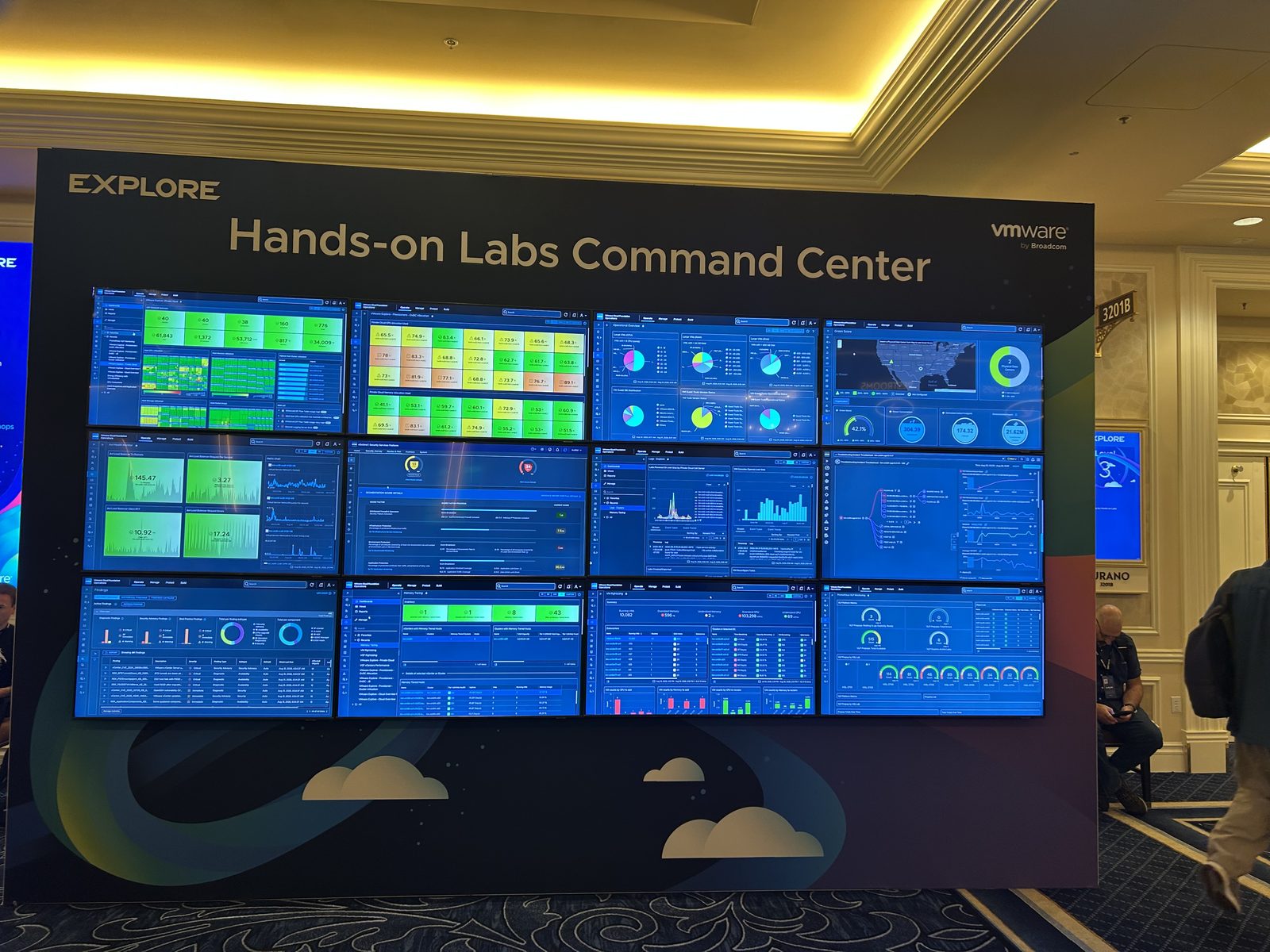
I stood in front of that wall for a while. Every panel on it is a view I have built by hand at one point or another — allocation percentages, host health, oversized and undersized VM counts, critical findings sorted by severity — assembled in a portal I wrote myself because nobody was going to build me one.
That wall is the entire argument of my infrastructure portal, rendered by a vendor with a design budget. Seeing it as a physical object in a hallway did more for my sense of whether that project was worth the nights than any session did. The idea is right. It was always the idea that was right.
One more thing, and it belongs to the following afternoon rather than to Monday. But Monday shouldn't get the last word on the week.
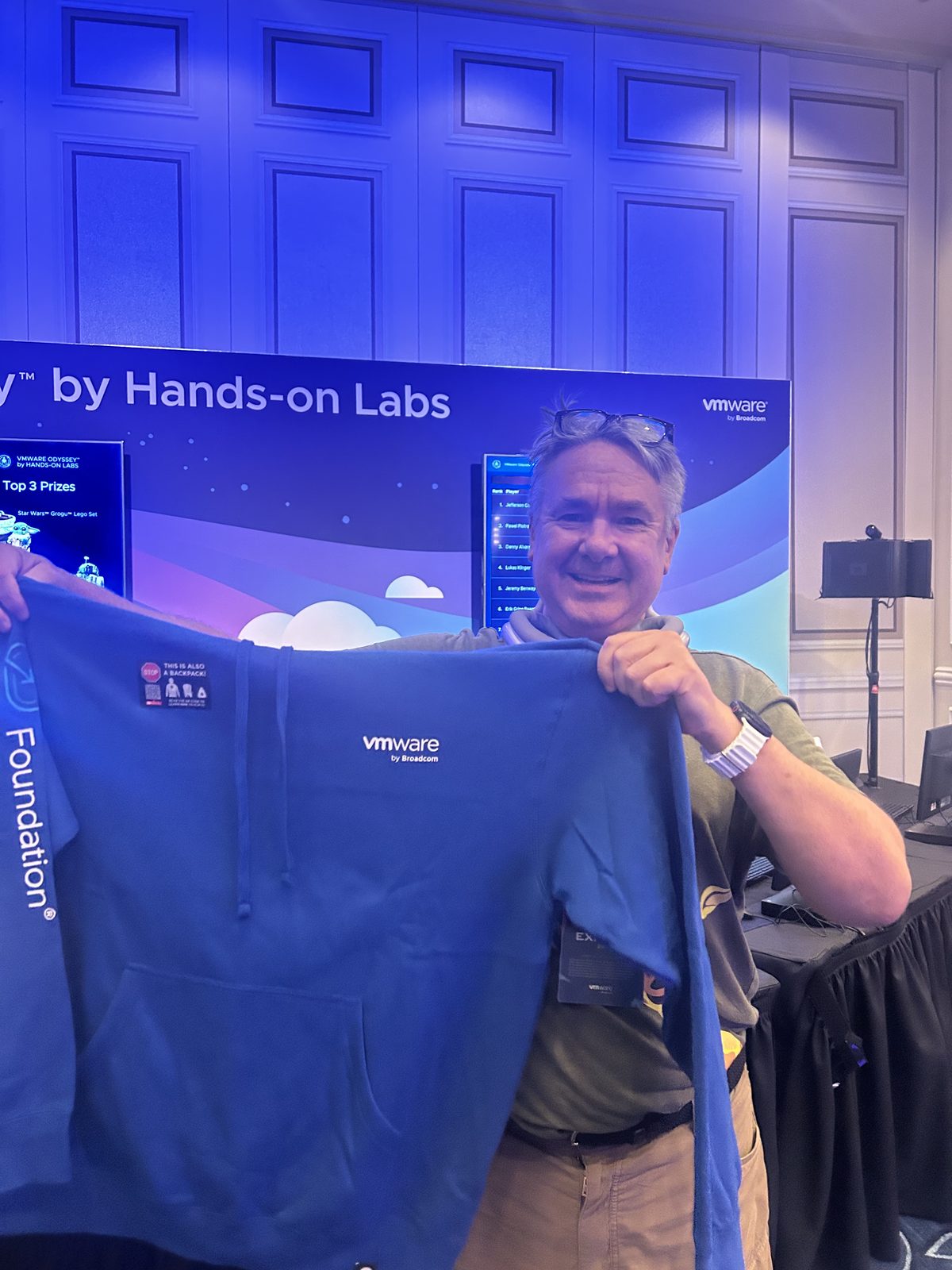
The Odyssey rounds are timed lab tasks on real VCF, scored on accuracy and how fast you finish. The drawing at the end isn't open to the whole floor — you get into it by working through the chain, and the chain is genuine work. That's the part I was pleased about. Winning the thing afterward was luck. Being in the pool at all wasn't.
Across the week I entered eight drawings and won one. That is roughly what eight drawings are for. The one that landed happened to be the only one I'd had to earn my way into, which I choose to read as the week making a point.
Monday was the day I gave something up. Tuesday was the day the week started handing things back.
May, and a different approach
Explore 2027 is at Resorts World, May 3rd through 6th. I'm registered. The hackathon project goes back on the bench and comes off it rebuilt — same premise, same 2 AM problem, but constructed from the start so the ownership question can't attach to it. That's a design constraint now, not a legal afterthought. It goes in at the beginning, the way you'd handle any other requirement you can't negotiate with.
Which is the thing I took home from day one, and it isn't about hackathons. The board at 8:52 is a proposal. It tells you what the day intends to be. What the day turns out to be depends on which of those items you'll trade when they collide, and you find out what your actual priorities are by watching what you walk away from — not by reading the plan you made in July.
I walked away from a keynote for a point total. I walked away from a stage for a piece of unfinished paperwork. Only one of those was the right call.